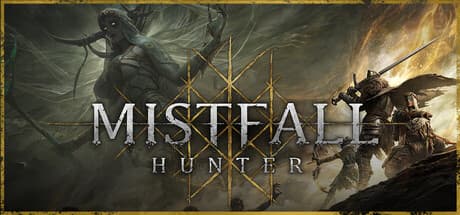
What kind of game is Mistfall Hunter?
Mistfall Hunter is a dark-fantasy, third-person PvPvE extraction action RPG. Bellring Games develops it, and Skystone Games publishes it. You play a Gyldhunter entering ruins corrupted by the Gyldenmist, looking for treasure while monsters and rival hunters compete for the same space. The important verb is not simply fight or loot. It is extract: an expedition becomes lasting progress only when you bring its rewards home.
That structure separates the game from a linear action RPG. A strong combat result can still become a failed hunt if you stay too long, take an unsafe route, or meet another group while short on healing. Conversely, avoiding a dramatic boss encounter can be the correct play when the inventory already holds what the account needs. The beginner guide develops that risk-first way of thinking.
The official PlayStation page describes free aiming, readable attack animations, active dodging, and weapon-and-skill combinations that change how a hunter fights. Those action systems sit inside an extraction structure, so mechanical skill and judgment matter together. Winning one exchange does not remove the need to plan a route out.
The extraction loop from camp to recovery
A hunt begins before loading into the dangerous area. At camp, you select a class, weapons, consumables, and an objective. That preparation defines what you are willing to risk. In the field, you explore terrain, open resource points, and fight ordinary enemies, elites, or bosses. Every encounter costs some combination of health, time, position, and supplies, even when it ends cleanly.
As loot accumulates, the decision changes. Continuing deeper may offer a better reward, but it also exposes a more valuable inventory to more threats. Other Gyldhunters can be fought, avoided, or routed around; they do not follow the reliable patterns of a fixed encounter. Eventually you locate and complete an extraction. Back at camp, recovered items can support storage, crafting, gear improvement, or a revised build for the next attempt.
Death usually means losing most of what was carried into and collected during that run. The PlayStation page also identifies Returner Woodling as a way for a downed hunter to return once. A return is another chance to act, not a completed extraction or a guarantee that the equipment is safe.
How PvP, PvE, extraction, and RPG systems meet
PvE enemies and bosses consume resources and can reveal where a hunter is fighting. PvP adds opponents who can wait, flank, withdraw, or arrive after hearing that battle. Extraction makes those pressures matter beyond a single duel because carried value remains exposed until departure. The RPG layer supplies class branches, skills, talents, equipment affixes, and gems that let two players approach the same role differently.
This combination makes information a resource. A monster group may be manageable in isolation, yet dangerous beside a noisy choke point. A rival may not need to defeat a boss if they can contest the exhausted team afterward. A quiet path can be more valuable than a fast one. Third-person sight lines, corners, sound, and terrain therefore shape combat alongside damage and defense.
The six base classes
The game has six base classes: Mercenary, Sorcerer, Shadowstrix, Blackarrow, Seer, and Withered Knight. Their specializations and balance can change how they perform, so this is an orientation rather than an official power ranking. See the contextual class tier list before treating any class as universally strongest.
| Base class | Broad identity | Useful starting preference |
|---|---|---|
| Mercenary | Melee pressure and a forgiving front line | Learning direct engagements |
| Sorcerer | Ranged spells, area pressure, and bursts | Managing distance and skill cycles |
| Shadowstrix | High mobility and assassin-style entry | Timing duels and escapes |
| Blackarrow | Bow range, pressure, and status effects | Opening fights from sight lines |
| Seer | Healing, shields, control, or curses | Supporting a coordinated team |
| Withered Knight | Armor, wither effects, and executions | Methodical trades and pressure |
These labels describe tendencies, not locked jobs. Weapon choices and branches change available tools, and the right evaluation depends on solo play, three-player squads, PvE, PvP, and the current patch.
Solo hunts and three-player squads
Official material supports entering alone or with a squad of up to three. Solo play concentrates every responsibility in one hunter: gathering information, choosing fights, sustaining through PvE, and preserving an exit. Without a teammate to cover a heal or control an approach, route knowledge and the willingness to disengage become especially important.
A three-player group can distribute front-line pressure, ranged damage, control, and support. That does not make the hunt automatic. A team that spreads too far cannot trade help quickly, while a team stacked in one doorway can be caught by the same area attack. Clear decisions about the objective and extraction prevent one person from extending a successful run for an unnecessary chest.
The PlayStation listing also gives an online-player maximum for the overall session. That store field should not be confused with the party limit: the supported squad size described by the official page is up to three.
Risk, loss, and lasting progress
Extraction games turn restraint into a progression skill. Items in storage are different from equipment exposed in the current hunt. A sensible loadout matches the purpose of the run and the loss you can accept. Once an inventory contains something that materially advances a task, build, or account, leaving is an active objective rather than an admission of defeat.
Recovery systems do not erase this economy. Returner Woodling can create a comeback, but the player still needs a safe route and a completed extraction. Exact protection rules and exceptions belong to the current in-game interface because patches can adjust them. The durable lesson is to judge value at risk after every major fight or pickup.
Official platform and PC facts
As checked for this guide, the official PlayStation product page lists a PS5 version, required online play, and PS5 Pro enhancement. It also states that direct character-stat boosts are not sold, although the current store page remains the authority for purchase boundaries. This guide does not infer cross-play or support for unlisted platforms.
The official Steam page lists a July 29, 2026 release, with regional displays potentially differing by a day because of time zones. Its PC requirements call for a 64-bit system and DirectX 12, with roughly 45 GB of storage. The listed minimum includes Windows 10, 12 GB of memory, and GTX 1060 or RX 580-class graphics; the recommendation lists 16 GB, RTX 2070 or RX 5700 XT-class graphics, and an SSD recommendation. Store editions, regional prices, tax, and discounts can change, so a permanent price would be misleading.
Who is likely to enjoy the hunt?
Mistfall Hunter suits players who want action combat to feed meaningful risk decisions. It rewards reading attacks, aiming, dodging, planning builds, learning maps, and stopping before greed converts a good expedition into a loss. Friends who enjoy distinct combat roles also have room to coordinate without expanding beyond a compact squad.
It may be a difficult fit for someone seeking an offline campaign, consequence-free experimentation in live hunts, or fully predictable encounters. New players must learn combat, resource value, routes, and extraction timing at once, while PvPvE allows another hunter to interrupt an otherwise controlled monster fight. Those pressures are the design rather than a temporary obstacle. If that combination sounds appealing, begin with inexpensive learning runs and treat every successful return as useful knowledge as well as loot.